Condos & HOAs
Condo & HOA Roofs
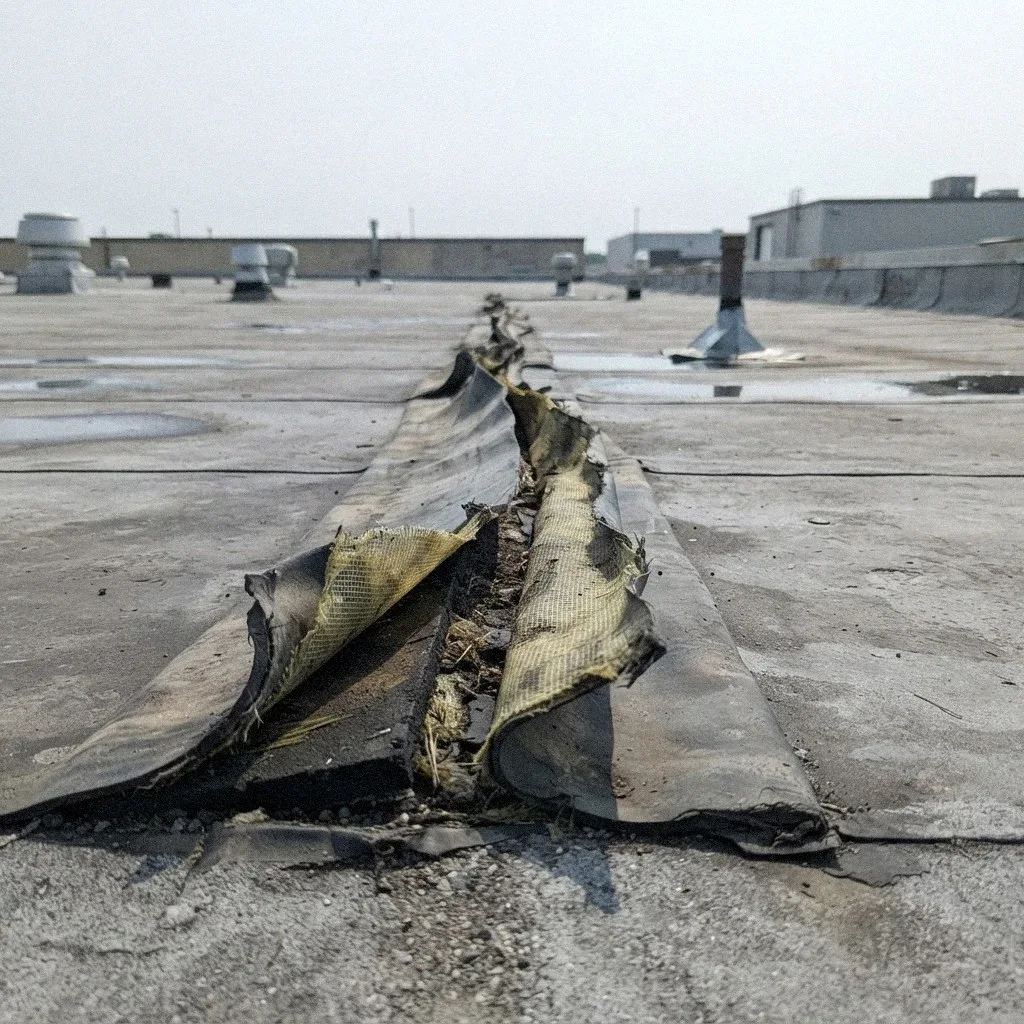
Section-by-section work across a large single-ply roof, without stopping dock operations.
Warehouse and light industrial roofs in Simi Valley are single-ply membrane, replaced or patched bay by bay so racking, product, and dock traffic keep moving. Work centers on field seams, fastening pattern, roof drains, overflow scupters, and aging skylight panels.
A warehouse or light industrial building in Simi Valley usually carries one continuous roof over a single open interior, and that scale is the whole problem. A leak twelve bays from the office can sit unnoticed for weeks while it stains racking and product below. Getting eyes on the whole field means walking it in sections, not just checking the spots someone happened to report from the floor underneath, near Tapo Canyon Road or the industrial stretches off Los Angeles Avenue.
Section-by-section phasing is how a crew tackles acres of single-ply without shutting the building down. One bay gets opened, patched or replaced, and closed in before the next starts, so the interior stays dry and operations keep running. On a Simi Valley property this matters most heading into a red flag warning day, when wind and ash can find any bay left uncovered overnight.
Buildings this size rarely fail all at once. A membrane can hold for years and then show trouble at a dozen separate points as fasteners loosen or a sump goes flat, which is why an inspection has to cover every bay rather than the one nearest the loading dock. That's a different job than checking a single-family tile roof in Wood Ranch or Bridle Path.
On a mechanically fastened system, rows of fasteners driven through the insulation board into the metal deck or purlin below hold the membrane against wind, and every field seam between sheets is a potential path for water if it isn't welded or sealed right. A fully adhered system skips most of the fasteners but leans harder on the seam itself. Either way, seam quality is what decides whether the roof holds during Santa Ana wind events.
Across a roof the size of a typical Simi Valley distribution building, seam length adds up into thousands of linear feet, and even a low failure rate per foot means real vulnerable spots somewhere in the field. Finding those before they leak means walking every seam run, not sampling a corner near the office entrance and calling the roof sound.
| Stage | Task | If Skipped |
|---|---|---|
| Attachment method | Mechanically fastened | Fully adhered |
| Field seam count | More seams, fastener rows | Fewer, bonded laps |
| Wind uplift resistance | Set by fastening pattern | Set by adhesive bond |
| Deck compatibility | Needs metal deck, purlin access | Works over insulation board |
| Phasing across bays | Clean section breaks | Clean section breaks |
| Common concern here | Fastener backout over time | Bond loss at old laps |
| Skylight panel inspection | Check aging translucent panels for clouding, cracks | Falling panel or leak over racking |
| Dock traffic staging | Sequence material staging around active loading docks | Blocked dock access halts shipments |
A roof this large drains through internal roof drains built into the field rather than gutters along an edge, with overflow scupper openings as backup if a drain clogs during a hard rain. The city has said plainly that every property in Simi Valley sits in some flood zone, and a warehouse roof that can't move water fast enough backs that risk up onto the membrane itself instead of down into a channel like the Arroyo Simi.
Each drain sits in a sump, a shallow low point built into the deck to pull water toward the opening. Sumps flatten out as insulation board compresses over years of foot traffic and weather, and a flat sump lets water sit rather than moving. That's a slow, quiet failure that doesn't show up until a bay starts leaking during one of the valley's short, intense winter storms.
Because the roof is one connected field, a single clogged drain or flattened sump doesn't stay local. Water finds the next lowest point and pools there instead, adding load across a wider stretch of membrane than the original problem. On a property near Tapo Canyon or the Arroyo Simi Greenway corridor, checking every drain and sump matters more than checking the one that's flooded before.
Older warehouse roofs around Simi Valley often still carry translucent skylight panels, set into the field to bring daylight into a building with few or no wall windows. Decades of Santa Ana sun bake these panels until they go brittle and yellow, and a brittle panel is a fall-through hazard for anyone walking the roof, not just a leak risk. Age is the main reason they get flagged during any roof-wide inspection.
Because each panel is set into the membrane rather than bolted on top of it, swapping one out means cutting and resealing the surrounding field seam carefully so the fix doesn't create a new leak path. On an older single-ply roof, that seam work has to match the existing system, which is part of why panel replacement takes more planning than it looks like from the warehouse floor.
What sits below a Simi Valley warehouse roof is usually the real reason a leak can't wait. Racking and product below can mean packaged goods, raw material, or equipment that a slow drip ruins long before anyone notices water on the floor. A leak that would just be a stain on drywall in a Wood Ranch home can mean a damaged pallet load here.
Exhaust fan curbs are another common weak point, since each one punches through the membrane to vent whatever process or loading activity runs underneath. The seal around a curb ages differently than the flat field around it, so it needs its own check rather than an assumption that a sound membrane means a sound curb. Neglected curbs are a frequent source of leaks traced back to the ceiling below.
Staging around a Simi Valley warehouse usually comes down to the dock doors, not the roof itself. A crew off Los Angeles Avenue or near the Arroyo Simi Greenway corridor plans the open bay away from active dock traffic first, then works toward the busiest doors last. Materials and torn-off membrane move through whichever bay is closed to trucks that week, so product movement below never has to stop for the section being reroofed above it.
That's why a project plan for a Simi Valley property has to account for dock schedules before the first bay opens, not after. Keeping a clear path for trucks moving along Los Angeles Avenue or Cochran Street to reach the dock matters as much as any decision about the membrane itself, since a blocked dock stops the business even if the roof work is going fine.
Loading dock access on a Simi Valley warehouse usually drives the sequence more than anything else. Trucks still need the dock doors open most days, so the section-by-section phasing saves the bays nearest heavy dock traffic for last. Materials stage on the far side of the roof, away from active doors, and each bay closes out with field seams sealed before the next one opens, so the building stays weathertight the whole time.
Red flag warning days do more than raise fire risk — sustained wind loosens ridge caps and lifts tile edges that then crack under foot traffic during the next repair. A property owner who waits for a visible leak after a windy stretch is usually looking at damage that started weeks earlier and went unnoticed.Agoura Hills, Calabasas and East Simi Valley. A slab foundation doesn't move the way older crawl-space homes do, but the roof above it still bears the brunt of long, hot, dry stretches followed by short bursts of hard rain. That swing between extremes is what actually shortens a roof's life here.
Age on paper means little once you compare actual roofs side by side. Slope, tree cover, and which walls catch afternoon sun all push wear rates apart. One side of a house can shed a roof's life a decade before the other. That's why a written inspection beats a guess every time.A fair number depends on what your roof actually needs, and that shows up only on the shingles or tile themselves. A property near Erringer Road or a hillside lot close to the Santa Susana Mountains may need different flashing work than a flat tract roof elsewhere in Simi Valley, so the licensed pros we connect you with price after a real look, not a guess. pricing guide, and the commercial overview covers how a scheduled program works.
Condo & HOA Roofs
Commercial Roofing
Multifamily Roofing
Yes. A single-ply reroof over a warehouse this size in Simi Valley is typically staged bay by bay, closing out one section's field seams before the next opens. That keeps racking and stored product under a finished roof at all times and lets dock doors near the busiest bays stay in use until their section comes up last in the sequence.
Translucent skylight panels usually show their age before the surrounding membrane does. On an older industrial building along Los Angeles Avenue, yellowing, hazing, or hairline cracking in the plastic often means the curb seal underneath is the actual leak path, not the field membrane. Panels get checked separately from the roof inspection for exactly this reason.
Roof drains and overflow scuppers both need checking, and Simi Valley's rain arrives in short, hard bursts rather than steady weeks of it. A drain bowl full of debris backs up fast during one of those storms, and a scupper that's clogged or set at the wrong height won't catch the overflow once the primary drains fall behind.
Sequencing by bay keeps a large single-ply roof weathertight the whole way through the job. One section gets closed out, seams sealed, before the crew opens the next, so a warehouse near the Arroyo Simi or off Los Angeles Avenue never has open, exposed bays stacked up if weather or a schedule shift catches the job mid-phase.
Get a bay-by-bay sequencing plan for your warehouse roof from the licensed pros we connect you with.
Call (805) 463-1431