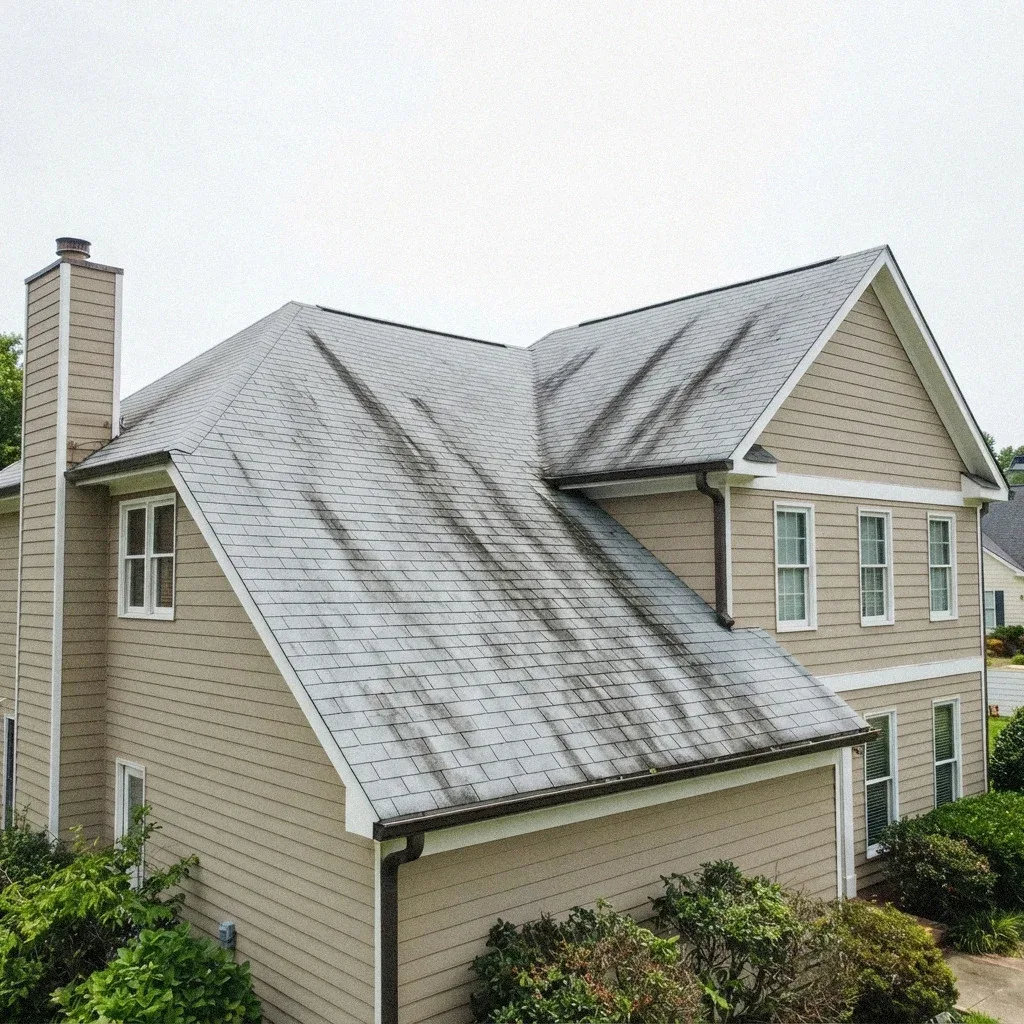
Moss, Algae, and Lichen on Simi Valley Roofs
Why shaded slopes near Wood Ranch and Santa Susana Knolls grow the most, and what actually treats it.
Moss and algae grow on Simi Valley roofs where shade and slow drainage keep shingles damp after the valley's winter storms. Moss lifts shingle edges and traps moisture; algae streaks granules. Soft-wash treatment removes both without the granule damage pressure washing causes.
Telling Moss, Algae, and Lichen Apart
Simi Valley's tract roofs face a dry, sunbaked climate most of the year, but the north-facing slopes on homes near Wood Ranch and Santa Susana Knolls stay cool and shaded long enough for spores to settle and take hold. Gloeocapsa magma shows up first as faint algae streaking, a gray-black smear that follows the granule pattern. True moss builds slower, forming a raised mat instead of a stain. Lichen is rarer here but shows up as a crusty, flat patch that bonds directly to the shingle surface rather than sitting on top of it.
Shade load matters more than roof age in Simi Valley. A tile or shingle roof under mature trees near Rancho Simi Community Park or along the Arroyo Simi Greenway can stay damp for days after the eaves on a sun-exposed Wood Ranch lot have gone bone dry. The valley heat that dries most surfaces fast simply never reaches a shaded plane long enough to matter. That gap in drying time, not the total rainfall, decides which roofs in this city grow moss and which never do.
Moisture retention under an established moss mat behaves differently than a puddle or a wet patch after a storm. Once moss roots into the granule layer, it holds a film of water against the shingle around the clock, even on days when Santa Ana winds have stripped humidity out of the air everywhere else in the valley. That constant dampness is what separates a roof with a passing wet spot from one with a standing biological problem that keeps working at the surface underneath it.
Why Shade Near Wood Ranch Feeds Growth
Granule adhesion breaks down first. The mineral granules on a composition shingle sit in an asphalt coating that blocks UV light from breaking the material down underneath. Moss holding water against that coating softens the asphalt's grip on the granules over time, and they start washing loose in the next hard rain off the Santa Susana Mountains. Once bare asphalt is exposed, sun exposure ages that patch of roof faster than the rest of the surface around it.
Shingle edge lifting shows up after moss has had a season or more to spread along a ridge or under a tab. The growth physically wedges the shingle away from the roof deck as it thickens, breaking the seal manufacturers rely on to keep wind and rain from working underneath. On a hillside lot near Santa Susana Pass or Rocky Peak, where gusts pick up on red flag warning days, a lifted edge gives wind something to grab that a flat, sealed shingle never would.
- Moss anchors into granule grooves and thatches into a mat that holds rainwater against the deck long after a Simi Valley storm passes. It thickens each wet season, prying tab edges upward and giving wind a place to grab during Santa Ana gusts.
- Gloeocapsa magma spreads as a thin sheet across the granule layer, feeding on the limestone filler some shingles contain. The result is the dark gray-black streaking seen on north-facing slopes near Wood Ranch and Tapo Canyon, cosmetic at first but a sign moisture is lingering.
- Lichen is a fungus and an alga growing as one organism, and it behaves differently from moss because it anchors directly into the shingle surface instead of just sitting on top. Removing an established lichen colony without damaging the granule layer beneath it takes more care than moss removal does.
- Shade load is the term for how many hours a day a given roof section sits out of direct sun. In Simi Valley, hillside lots near Santa Susana Pass and mature trees around older Old Town properties create pockets of shade that hold moisture far longer than open, sun-facing slopes.
- Moisture retention decides whether a spore can establish at all once it lands on a shingle. A roof that dries out within hours under valley heat rarely grows moss, while a shaded section near a canyon lot can stay damp long enough after a winter storm for a colony to take root.
- Slopes facing away from direct sun, and any section shaded by mature trees, dry slower after Simi Valley's winter storms than open slopes that get full afternoon exposure. That extra drying time is what lets moss and algae establish in the first place.
How Growth Lifts and Wears Shingles
Pressure washing a moss-covered shingle roof in Simi Valley does more harm than the moss itself. A tight water jet blasts granules loose along with the moss, and on an older tile or composition roof that's already spent 20 summers under direct sun, that surface has little reserve left to lose. The force can also drive water up under flashing near a chimney or valley, finding a path into the attic that the moss growth never created on its own.
A soft wash approach treats the organism instead of scrubbing at the surface. A diluted cleaning solution is applied at low pressure and left to sit, breaking down the moss and any algae streaking at the cell level so it can be rinsed free with a gentle, low-pressure rinse rather than dislodged by force. Applied correctly by pros who know how the chemical interacts with both composition and clay tile, it clears growth without stripping the granule layer or the tile's surface glaze underneath.
- Moss growing under a shingle tab thickens over a season and pries the tab edge upward as it does. That lifted edge breaks the seal meant to shed wind-driven rain, and once it's open, water gets past the tab surface on the next storm that rolls through Ventura County.
- Granule adhesion breaks down wherever moss or lichen has rooted into the shingle mat, and the bare asphalt underneath is left exposed to direct sun and Santa Ana wind cycles. This wears a shingle down on its own timeline, separate from any leak caused by a lifted edge.
- Shingle edge lifting shows up most along the bottom edge of a slope and at valleys, where moss holds the thickest mat and water sits longest after it drains off the rest of the field. Once the seal there is broken, wind-driven rain from a Santa Ana event finds the opening easily.
- None of this damage happens quickly in a climate this dry. Moss and lichen need a full wet season or more to build up enough growth to lift a shingle edge, which is why a yearly check timed after winter storms usually catches it before it becomes a leak.
Three Organisms Side by Side
Zinc strip and copper strip installation only heads off growth that hasn't started yet; it does nothing for moss already established near a ridge on a Presidential Tract or Berylwood home. Mounted just below the ridge line, the metal releases ions that wash downslope every time it rains, creating conditions spores can't easily colonize. It's a maintenance step, not a fix, and it works best paired with a soft wash treatment on a roof that already shows algae streaking or matted growth.
Zinc and copper strips work by a different mechanism than treatment. Rain carries trace metal ions down the slope, and gloeocapsa magma cannot establish where that runoff lands. Simi Valley homes on shaded lots near Santa Susana or Wood Ranch benefit most, since sun-exposed roofs elsewhere in the valley already limit moisture retention on their own. Strips need replacing periodically as the metal wears thin, and they only protect the wash path below them, not the whole roof.
| Growth | Look | Risk |
|---|---|---|
| How moss spreads and holds | Thick green mats, holds water | Lifts shingle tabs, breaks seal |
| Gloeocapsa magma algae | Dark streaking, worst on north slopes | Feeds on granule limestone filler |
| Algae colony (gloeocapsa magma) | Gray-green crusty patches, flat and rooted | Bonds to granules, pulls them free |
| Zinc or copper strips | Metal strips near the ridge | Runoff slows regrowth over time |
| Removal method | Soft wash, low-pressure rinse | Clears growth without stripping granules |
Treatment Methods That Protect the Shingle
Zinc and copper strips work on a delay, not on contact. Ion-laced rainwater has to travel across the shingle surface to reach spores lower on the slope, so a strip near the ridge protects a wide band below it but does little for growth that's already rooted at the eaves or in a valley far from that runoff path. It's most effective installed before growth appears, on a roof plane shaded most hours by trees near Sinaloa Lake or the hills above Santa Susana.
Tree canopy trimming changes drying time more than it changes shade. A homeowner near Bridle Path or Big Sky weighing a trim against a roof cleaning should focus on airflow: opening gaps in overhanging branches so wind and afternoon sun reach the shingles for even a short stretch each day cuts the hours a roof plane stays wet after a storm rolling off the Santa Susana Mountains. Less time wet means fewer growing seasons for spores to establish before the next dry spell arrives.
Building a Maintenance Schedule That Holds
How often a Simi Valley roof needs checking for moss depends on where the house sits more than how old the roof is. Homes tucked against tree cover near Sage Ranch Park or Corriganville Regional Park hold moisture longer after winter rain and need a look every year. A roof on an open lot in Wood Ranch or Big Sky, baking under valley sun most afternoons, can often go two or three years between inspections since growth rarely gets a foothold there in the first place.
Rather than marking a date on a calendar, tie the check to the weather this city actually gets. Walk the roof, or have it looked at, after the wettest stretch of winter has passed and again before the dry season sets in and Santa Ana wind events pick up. That two-visit rhythm catches moss while it's still thin enough for a soft wash to handle, well before it reaches the point of lifting shingle edges or loosening granules underneath.
What Grows Where, and Why
- A zinc strip or copper strip releases trace metal that rinses down the roof face in each rain, discouraging new moss and lichen from establishing below the strip line. It works gradually and needs rain to activate, so it does less during Simi Valley's long dry summer stretch.
- Pressure washing a composition shingle roof strips granules and drives water under the tabs, and it's the most common cause of damage that shows up worse than the moss it was meant to remove. A soft wash and low-pressure rinse avoid that outcome on both shingle and tile.
- A copper strip near the ridge line sends metal ions down the slope with every rain, slowing regrowth on the section below it, though homes on Bridle Path or Big Sky with steep hillside pitches may still need periodic soft-wash treatment between installs.
- Algae-resistant shingle has copper granules built into the product at manufacture, which is worth raising with the licensed pros we connect you with if a reroof is already planned for a home in Wood Ranch or elsewhere in the valley with heavy shade load.
- Trimming back tree canopy that shades a roof section cuts down the shade load and lets afternoon sun reach shingles that used to stay damp. It will not undo existing growth, but it slows how fast moss and algae come back after treatment.
- A yearly check timed between late spring and early fall, after Simi Valley's brief wet season ends, is enough to catch moss and lichen while they're still small. Waiting until the following winter storm often means dealing with shingle edge lifting instead of surface growth alone.
Frequently Asked Questions
Is moss actually bad for my roof?
It depends on how long it's been there. Light algae streaking with no lifted edges on a Simi Valley roof is mostly cosmetic. But moss that has held moisture against the shingles through more than one wet season can loosen granules and lift edges, especially on shaded, north-facing planes near tree cover. At that stage it's a maintenance issue worth a soft wash treatment, not just an appearance problem to ignore.
What causes the black streaks on my roof?
Gloeocapsa magma is the blue-green algae that causes the dark streaking seen on north-facing slopes across Wood Ranch and Santa Susana Knolls. It feeds on limestone filler in shingle granules and spreads by wind and water, favoring roof sections that stay damp longer under tile overlaps or tree cover near Sinaloa Lake.
How does moss lift my shingles?
Moss grows in thick mats that trap water against the shingle mat and push into the gap under each tab. As it thickens it lifts the tab edge, breaking the seal that keeps rain out during Simi Valley's short but hard winter storms, and granule loss follows once the mat is established.
What is a soft wash roof treatment?
Yes, licensed pros use sodium hypochlorite at low pressure to kill growth without stripping the granules that shed Simi Valley's summer heat. A garden-hose pressure washer forces water under tabs on Wood Ranch and Bridle Path tract roofs, loosening the seal and shortening the roof's life instead of cleaning it safely.
How often should I have my roof cleaned?
Every two to three years for most Simi Valley homes, but a shaded slope under mature trees near Bridle Path or Sinaloa Lake may need a look every year. Roofs that see full Santa Ana sun on open, unshaded tracts stay dry enough that growth checks can stretch out further between visits.
Wondering What's Growing on Your Roof?
Ask the licensed pros we connect you with to check moss and algae growth before it lifts shingle edges on your Simi Valley roof.
Call (805) 463-1431