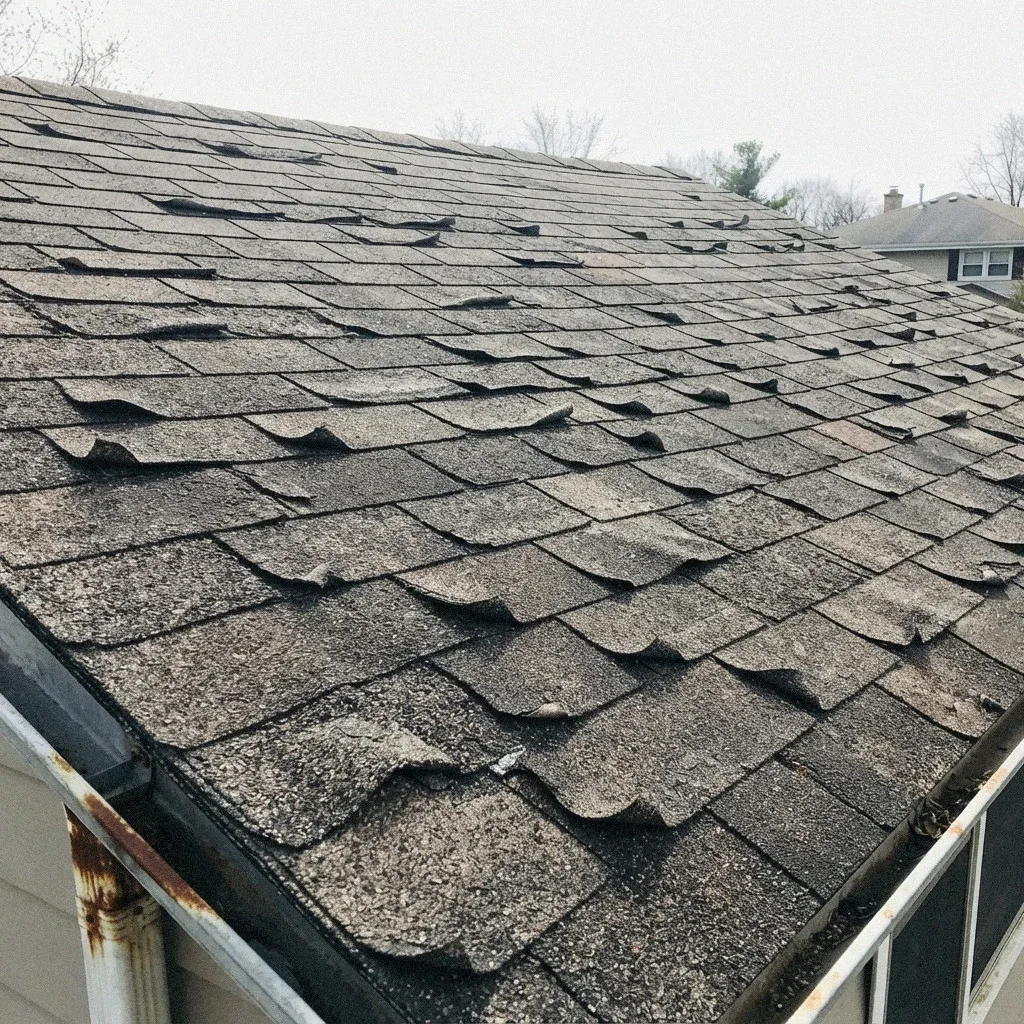
How Shingles Age Under Simi Valley Sun
Every asphalt shingle roof in Simi Valley moves through predictable stages before it reaches end of service life.
Rated life is a lab estimate; achieved life is what a Simi Valley roof actually reaches after years of direct sun and Santa Ana wind cycling. Many shingles here fall short of the rated number by several years.
Lab Rating Versus Real Roof Life
A thirty-year shingle rarely gives a Simi Valley roof thirty years. The rating comes from lab testing under controlled heat cycles, not from a tract home baking under direct sun through Tapo Canyon or Wood Ranch all summer. Add repeated Santa Ana wind events, red flag warning days, and steep west-facing slopes near the Santa Susana Mountains, and the achieved life on many roofs lands well short of the number stamped on the wrapper. Rated life sets an expectation; the valley heat and wind decide what actually happens.
Three-tab shingles and architectural shingles do not age the same way, and the gap widens fast in a Simi Valley summer. Three-tab shingles are thinner and single-layer, with less mass to absorb thermal movement, so they show curling and edge wear sooner. Architectural shingles laminate two layers together, giving more resistance to wind uplift and better performance against direct sun exposure on hillside lots. Neither is immune to the valley's heat swings, but the architectural product typically buys a homeowner several extra years before real trouble starts.
Fiberglass mat shingles took over the market decades ago because they resist fire better than older organic-mat products, which matters directly here given how often Simi Valley sits under wildfire concern from the surrounding hills. But the fiberglass mat does not change the asphalt coating's basic chemistry. UV degradation and thermal cycling still break down the asphalt binder over time, regardless of what's woven underneath it. A roof over Bridle Path or Big Sky ages on the same asphalt clock as anywhere else in the valley.
Condition By Decade On A Valley Roof
Granule loss on a Simi Valley roof tends to start at the ridge lines and south- and west-facing slopes, the surfaces that take the most direct sun through the long dry season. Once the asphalt coating loses its granule cover, it's exposed straight to UV degradation with nothing buffering it. This shows up faster on homes near open hillside terrain in Santa Susana or Corriganville, where there's little tree canopy to soften afternoon exposure. A roof shaded by mature trees in an older Old Town lot often shows less wear at the same age.
Simi Valley shingles run through this cycle fast. Summer roof-deck temperatures climb well past air temperature under direct sun, and that daily swing between hot afternoons and cooler nights drives thermal cycling that flexes the fiberglass mat underneath the granules. By year ten to fifteen, most three-tab shingle roofs show a stiffer, less pliable surface, and the sealant strip that once welded courses together has started losing its grip along ridgelines and any slope exposed to Santa Ana winds.
- Years one through five, sealant strips finish bonding under Simi Valley's summer heat and the fiberglass mat sits protected under a full granule coat. Expect only minor color settling. Tract homes in Wood Ranch and Bridle Path at this stage rarely show wind uplift or lifted tabs.
- Years six through twelve: UV degradation starts thinning the asphalt mat's surface oils on south and west-facing slopes. Granule loss becomes visible in gutters and at downspouts. Homes on unshaded hillside lots near Santa Susana Knolls often show this stage earlier than shaded flatland tracts.
- Years thirteen through eighteen: thermal cycling from hot afternoons and cooler nights starts producing light cupping and clawing at tab edges. Nail pop can appear where original framing settled. Sealant strip bond weakens further, and tabs start lifting slightly during red flag warning wind events.
- Years nineteen through twenty-four: the mat has lost most of its flexibility, so tabs that were merely cupped start cracking through when anyone walks on them. Granule cover thins to bare patches on the west slope. Repairs still work at this stage, but each one is harder to blend, because new shingles no longer match a roof this faded.
- Years twenty-five and beyond: blistering and widespread cupping signal the mat has absorbed years of heat cycling with little protection left. Bare patches appear where granules have fully shed. Wind uplift risk rises sharply during Santa Ana events, and flashing leaks around valleys become more frequent.
- End of service life is not a single date on a calendar. It arrives when granule loss exposes the mat broadly, sealant strips no longer resist Santa Ana gusts, and cupping or curling keeps water from sheeting off cleanly during winter downpours.
Granules, Sealant Strips, And Grip Loss
Granule loss doesn't happen in one steady slide; it moves in stages. The first stage is cosmetic, just manufacturing excess rinsing off in early rains and collecting in gutters near the downspouts. Mid-life loss is different: it exposes the asphalt coating itself to direct sun, and that's when the real aging clock starts running faster. Late-stage loss leaves bare mat visible in patches, usually along ridgelines and south-facing slopes that catch the most Simi Valley sun through a long, dry season.
Sealant strip failure gets blamed on granule loss, but it's a separate mechanism. The self-sealing strip that bonds one shingle course to the one below it can lose adhesion from age, from repeated flexing during wind events, or from installation in cooler weather that never let the strip fully bond in the first place. A failed strip means tabs lift in wind rather than staying pinned flat. On a hillside lot exposed to regular Santa Ana gusts, a weak seal shows up as loose tabs years before granule loss alone would explain the damage.
- Granule cover, sealant strip bond and fastener grip wear on three separate clocks, and a roof is only as sound as whichever one gave out first. Granules go to sun, sealant strips to heat cycling, and fastener grip to the small movements of framing and deck. A roof can look evenly worn from the street while one of the three is years ahead of the others.
- Attic ventilation controls how much heat builds under the shingle mat during valley summers. Older tract homes with undersized or blocked vents trap hot air against the deck, which speeds blistering and UV degradation faster than a well-ventilated attic on the same street.
- Flashing, valley, and gutter condition decide whether water clears fast or lingers. On homes near Sinaloa Lake or along Arroyo Simi's feeder canyons, undersized gutters can leave shingle edges wet longer after the valley's occasional intense winter storms.
- Roof pitch and shade change how fast a shingle recovers from thermal cycling. Low-slope sections and roofs shaded by mature trees near Rancho Simi Community Park hold heat and moisture differently than open, sun-exposed hillside lots above Wood Ranch.
Cupping, Clawing, And Curling Explained
Cupping, clawing, and curling are stages, not separate defects. Cupping bends tab edges upward first, while the tab center stays flat. Clawing follows as the tab twists at multiple points instead of one clean bend. Curling is the general term for either stage. On Simi Valley roofs baking under direct sun near Rancho Simi Community Park or the Arroyo Simi corridor, cupping often shows years before full clawing sets in.
Cracking and splitting show up once UV degradation and years of thermal cycling have burned off the asphalt's remaining flexibility, so the mat itself fractures instead of just deforming. Blistering often precedes this stage, small raised bubbles where trapped moisture or gas pushed the surface up before popping and exposing bare mat. Nail pop is a separate mechanical issue, where fasteners back out with deck movement or shrinkage, lifting a shingle corner and inviting wind uplift on the next red flag warning day.
| Stage | Look | Cause |
|---|---|---|
| Years 1 to 5 | Tab edges lift slightly, center stays flat | Early sealant strip stress from heat cycling |
| Years 6 to 12 | Edges cup more, granules shift toward center | UV degradation stiffening the fiberglass mat |
| Years 13 to 20 | Tab claws and twists along its length | Repeated Santa Ana thermal cycling, sun exposure |
| Years 20 and beyond | Raised blisters that crack when walked on | Trapped gas or moisture beneath the mat |
| Cupping edges after granule loss | Tab edges lift while the center stays flat | Sun-side mat drying faster than the rest |
Reading The Signs Of A Worn-Out Roof
Install quality sets a hard ceiling on how long any shingle lasts here, no matter what the rated life says. Fastener count, nailing height, and whether shingles were laid tight against the course below all affect how the roof handles wind uplift during a Santa Ana event. A shingle nailed too high or too few times will show nail pop and edge lift years before a properly fastened roof on the same street. This shows up in older neighborhoods near the Los Angeles Avenue corridor where re-roofs from different decades sit side by side.
None of that is visible from the driveway, which is the awkward part. Read a roof from the ground and you see color and missing tabs, not nailing height, not fastener count, and not whether the underlayment was lapped the right way. It is why two roofs of the same age on the same street can be five years apart in real condition. Paperwork closes some of that gap: a permit record, the manufacturer's installation instructions, and photographs taken before the covering went down say more about how long a roof will last than the number printed on the bundle.
Deciding A Roof Has Run Its Course
End-of-life signs rarely show up as one dramatic failure. They build gradually: granules piling up in gutters after every rain, tabs that no longer lie flat after a Santa Ana wind event, bare patches on south-facing slopes, and cracked shingles scattered rather than concentrated in one spot. Blistering across the surface, where trapped moisture pushed up small bubbles that later popped, is another sign the coating has broken down. On its own none of these means the roof is done, but together they describe a shingle nearing its end of service life.
Spotting end of service life takes more than a glance from the driveway on Los Angeles Avenue. Bald patches where granules are gone, shingles that crack when lightly flexed, and widespread cupping or clawing across a slope all point past routine wear. A roof near Wood Ranch or Bridle Path with tile can hide age differently than a shingle roof in an older Simi Valley tract, so checking from a ladder or with binoculars beats guessing from the street.
What A Baking Roof Tells You
- A roof in this valley rarely wears evenly. South and west slopes take the afternoon sun and age well ahead of the north slope on the same house, so half a roof can be near the end of its life while the other half still looks sound. Judging the whole roof by the side visible from the street is how one gets replaced too early, or left too late.
- Heat is the dominant local stressor, not moisture. Repeated thermal cycling between hot Simi Valley afternoons and cooler nights fatigues the asphalt mat and sealant strips faster than the region's light 13 to 20 inches of annual rainfall ever does on its own.
- Granule loss in year one or two is normal shedding of loose factory granules rinsing off in early rains. Granule loss after year ten, especially in bare patches, signals mat exposure, UV degradation, and accelerating blistering underneath.
- Cupping and clawing mark two points on the same curling timeline, not two different problems. Cupping lifts the tab edges first; later the tab twists further along its length, which usually means the fiberglass mat underneath has lost flexibility from years of UV exposure.
- Nail pops trace back to framing movement and thermal cycling, not bad nails alone. Once a nail backs out, it opens a small gap where water can reach the underlayment, often going unnoticed until a ceiling stain shows up after a winter storm.
- A roof past end of service life rarely leaks everywhere at once. It typically fails first at valleys, chimney flashing, and low-slope sections, where water collects longest and sealant strips gave out earliest.
Frequently Asked Questions
How long do asphalt shingles really last here?
Rated life is the number from accelerated lab testing; achieved life is what the shingle actually reaches on a Simi Valley roof, shaped by direct sun, Santa Ana wind events, and attic ventilation. A shingle rated for thirty years might reach twenty on a west-facing slope with poor airflow, or closer to its rating on a shaded, well-ventilated roof. The lab number is a ceiling, not a promise.
Does Simi Valley heat wear out shingles faster?
Not usually from heat alone. Simi Valley shingle failures mostly trace to UV degradation and thermal cycling from repeated Santa Ana wind swings and long summer highs, not moisture the way coastal or shaded northern cities see. Sealant strips bake and lose flexibility faster on south and west-facing slopes exposed to the valley's full afternoon sun.
Why is my roof aging faster than it should?
Rated life assumes correct nailing, adequate ventilation, and normal drainage. On many 1970s and 1980s tract homes in Simi Valley, aging attic ventilation and unshaded roof decks push shingles to hit granule loss and cracking well before the rated number, especially on south-facing slopes above a slab foundation.
Does granule loss mean my roof needs replacing?
Granule loss matters, but it's one signal among several. A roof near end of service life usually shows granule loss alongside cupping, clawing at tab edges, and sealant strips that no longer hold tabs down against Santa Ana gusts. Any one sign alone is less telling than two or three appearing together.
Why do some Simi Valley roofs age unevenly?
Many Simi Valley tract homes built in the 60s through 80s carry the original asphalt shingle roof, and neighborhoods like Wood Ranch or Big Sky with mixed roofing show every stage side by side. A roof inspection is the only way to know where a specific house sits in that range.
Wondering Where Your Roof Sits On This Timeline?
Granule loss, cupping, lifted tabs: the stage a roof has reached decides whether it needs a repair or a tear-off. The licensed pros we connect you with will tell you which.
Call (805) 463-1431